




Incentives
What is a TIF?
Tax Incentive Fianancing
blank
TIF Districts
Fairview Heights TIF Exclusions
Excluded from eligibility are costs of construction of new privately-owned buildings. One hundred percent of the developer’s labor will be provided by contractors using labor provided by participating member trade unions affiliated with the Southwestern Illinois Building and Trades Council.
Applying for a TIF
The TIF application process is detailed in the documents attached. Prior to the City executing the Development Agreement, the applicant must pay a ‘Business Assistance Application Fee’ (the fee) equal to 2% of the Total Project Cost, not to exceed $500.00. The fee covers the cost of legal review, analysis, and processing of the application. The Fee is non-refundable, but should the project be delayed or terminated by actions of the City of Fairview Heights, such fee will be reimbursed.
If you wish to apply for a TIF, please download the application below and send it to the City of Fairview Heights’ Director of Land Use.
TIF Application Process
The following process applies only to TIF Program applications. Site Development Plan Review Applications, Zoning Applications, and other City applications follow separate review and approval procedures. The Business Assistance Program review process typically takes 3–4 months, although timelines may vary depending on project complexity and statutory requirements. No construction may begin and no project costs should be incurred until the City Council has approved the Development Agreement.
blank
1. Submit Your Application
2. Initial Staff Review
Upon receipt of a fully completed Business Assistance Programs Application (hereinafter “application”), the Director of Economic Development shall review and distribute the application to the Mayor, City Administrator, Director of Land Use, Planning, and Development, and the Finance Director (hereinafter the “Business Assistance Program Review Panel or Review Panel”) for preliminary review. The application shall also be submitted to the City Attorney for preliminary review. The Review Panel and the City Attorney shall conduct a preliminary review of the application using the following criteria:
- Soundness of the applicant’s proposed project;
- Legal compliance of projects with applicable State Statutes, local ordinances, policies, and guidelines;
- The nature and extent to which the proposed project furthers the goals and objectives of the Tax Increment Financing Redevelopment Plan or the Business District Plan;
- Financial feasibility of the project’s success; and
- Any other areas of concern regarding the proposed project.
3. Review Panel Meeting
Within two (2) weeks* of distribution, the Review Panel will convene privately to discuss the project.
4. Applicant Presentation
Within two (2) weeks* after the Review Panel convenes, the applicant will be contacted to schedule a presentation of the project to the Review Panel.
5. Receive Initial Feedback
Within two (2) weeks* after the date on which the applicant presents the project to the Review Panel, the Economic Development Director shall prepare and submit a letter to the applicant (letter to the applicant) outlining the strengths and weaknesses of the project, including an explanation of any changes required before the application can advance, with copy to the Lincoln Trail TIF Committee.
6. Committee Agenda Placement
Within two (2) weeks* after the date on which the letter to the applicant is sent, or within ten (10) weeks* after the application is initially distributed to the Review Panel, whichever is later, the applications will be placed onto the agenda for the next regularly scheduled public meeting of the Committee meeting. If, after two weeks from the date on which the letter to the applicant was sent, the application fails to meet the requirements outlined in the letter to the applicant, such application shall be deemed withdrawn.
7. Staff Report & Letter of Intent Preparation
Upon receipt of an application which meets the requirements outlined in the letter to the applicant, the Economic Development Department shall prepare a Staff Advisory Report outlining the strengths and weaknesses of the project for the benefit and assistance of the Committee in considering the application. The Economic Development Department shall also prepare a Letter of Intent (See Appendix 3) for the benefit and assistance of the Committee in reviewing the project.
8. Lincoln Trail TIF Committee Review
After consideration by the Committee at a public meeting, the Committee shall review and consider the Letter of Intent and recommend either approval of the Letter of Intent or denial of the application, to the Finance Committee.
9. Finance Committee Review
At the next regularly scheduled meeting of the Finance Committee, the Committee shall review and consider the recommendation of the Committee on the Letter of Intent and shall recommend either approval of the Letter of Intent or denial of the application, to the City Council. If the Finance Committee approves the Letter of Intent, it shall sponsor a Resolution approving the Letter of Intent before the City Council.
10. City Council Letter of Intent Approval
At the next regularly scheduled meeting of the City Council, the Council shall review and consider a Resolution approving the Letter of Intent. The City Council shall approve the Resolution, deny the application, or refer the matter back to the Finance Committee with directions for reconsideration. If the City Council approves the Resolution by a simple majority of a quorum of the members present, the Economic Development Department shall begin preparing and negotiate a Development Agreement with the applicant. The Review Panel and City Attorney shall participate in the negotiation process as necessary. The City Clerk shall make available for public inspection the redevelopment plan under which the proposed project shall proceed.
11. Development Agreement Review
Upon payment of the Business Assistance Program Application Fee, the proposed Development Agreement shall be placed onto the agenda for the next regularly scheduled Finance Committee meeting, at which the Finance Committee shall review the proposed Development Agreement. The Finance Committee shall either refer the matter back to the Economic Development Department with directions for further revisions or approve the proposed Development Agreement and advance it to the City Council for review.**
*The time frames stated herein, except where required by statute, are advisory and not mandatory. Depending upon the complexity of the application, the City estimates that the Business Assistance. Program Application review process will be completed within three (3) to four (4) months.
**Until City Council approves the Development Agreement, no construction shall commence and no costs should be incurred.
Enterprise Zone
The Illinois Enterprise Zone Program is designed to stimulate economic growth and neighborhood revitalization in economically depressed areas of the state through state and local tax incentives, regulatory relief, and improved governmental services.
blank
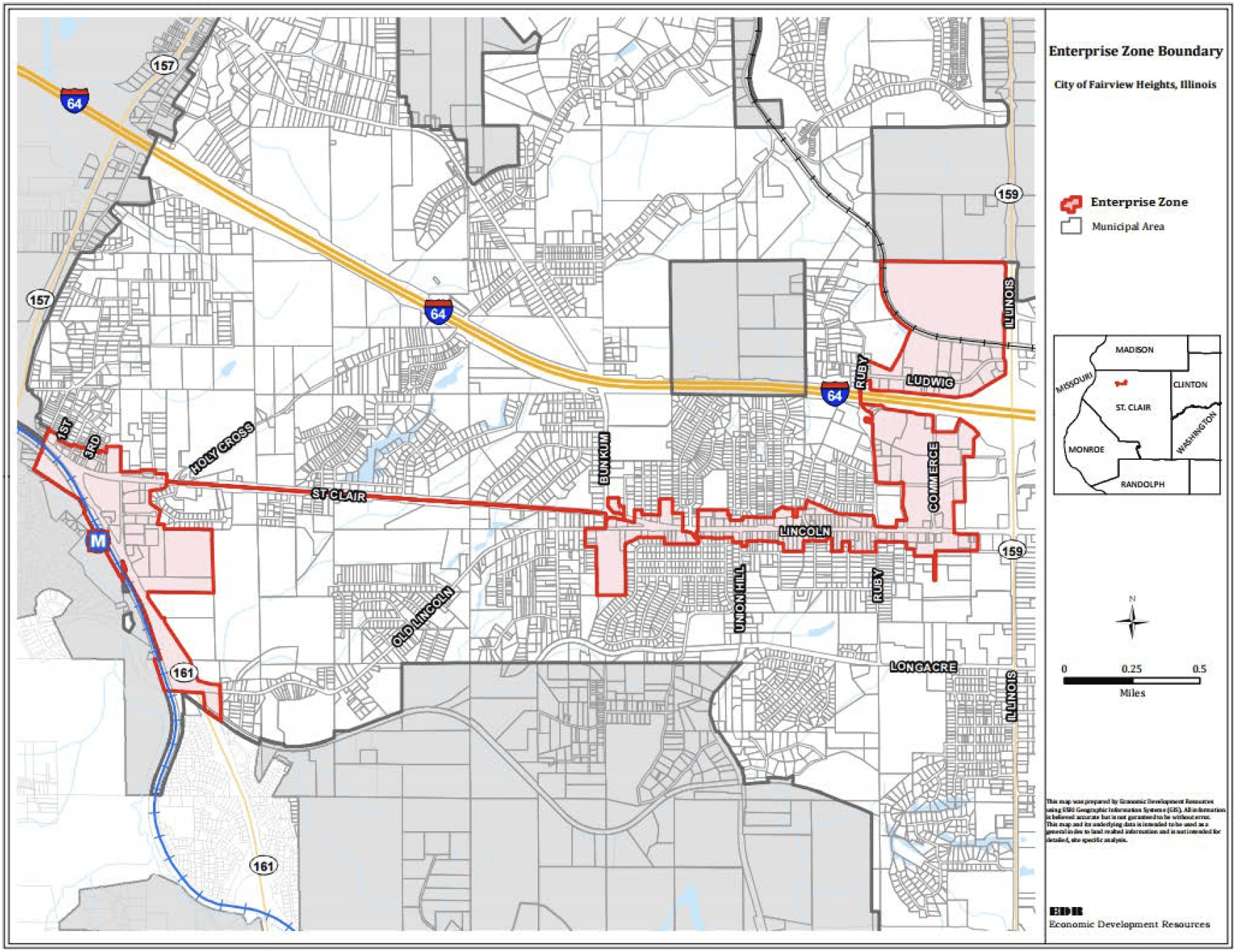
Enterprise Zone Boundaries
The size of the Enterprise Zone is 0.8 sq. miles. The boundary of the Enterprise Zone includes all property in the existing Lincoln Trail Tax Increment Financing (TIF) area and all property in the Fairview Heights TIF #4, Ludwig Drive TIF, and the State Route 159 TIF. A 5-foot strip along St. Clair Avenue is used to connect these areas in the Enterprise Zone. In addition, the City has also placed commercial properties on the south side of Ludwig Drive at Fairview Heights Plaza within the boundary of the Enterprise Zone. The size of the Enterprise Zone is within size limitations established by the Illinois Enterprise Zone Act (20 ILCS 655/1 et seq.).
The Local Labor Market Area (LLMA) for the Fairview Heights Enterprise Zone is St. Clair County. The LLMA is contiguous, compact, comprised of entire census tracts, located entirely within the State of Illinois, and is an area within which residents of the LLMA can easily change jobs and do not have to relocate outside of its boundaries.
Enterprise Zone Development Plan
Make Lincoln Trail TIF corridor a viable commercial retail portion of the City via:
1. Ongoing redevelopment efforts along Lincoln Trail TIF corridor (public/private effort)
2. Provide additional Enterprise Zone incentive to existing Lincoln Trail TIF;
3. Create uniformity and new “development standard” for this commercial corridor;
4. Use Enterprise Zone incentive to convert uses along Lincoln Trail to commercial; and
5. Incorporate mixed-use combined retail and residential centers along Lincoln Trail.
Fill vacancies and redevelop Fairview Heights Plaza at IL 159 and Ludwig (public/private):
1. Work with property owner on façade, landscaping and parking lot improvements;
2. Bring building interiors up to code compliance; subdivide building space for new users; and
3. Remediate physical environmental obstacles required to (re)develop 72 acres of vacant property across railroad tracks.
Create mixed-use destination district surrounding Fairview Heights MetroLink station:
1. Utilize four-phase 20-year plan developed by OneSTL to redevelop existing uses into new mixed-use district and develop new Arrowhead industrial park;
2. Utilize Enterprise Zone and TIF incentives to offset high property tax rates;
3. Incorporate senior living component into mixed-use district surrounding MetroLink; and
4. Work with MetroLink to improve/lease Metro property before making improvements.
Incentives and Exemptions
- Exemption on retailers’ occupation tax paid on building materials
- An investment tax credit of 0.5% of qualified property
- Expanded state sales tax exemptions on purchases of personal property used or consumed in the manufacturing process or in the operation of a pollution control facility
- An exemption on the state utility tax for electricity and natural gas
- An exemption on the Illinois Commerce Commission’s administrative charge and telecommunication excise tax.
Exemptions are available for companies that make minimum investments that either create or retain a certain number of jobs. These exemptions require a business to make application to, and be certified by, the Illinois Department of Commerce.
In addition to state incentives, each zone offers local incentives to enhance business development projects. Each zone has a designated local zone administrator responsible for compliance and is available to answer questions. To receive a Certificate of Eligibility for Sales Tax Exemption, you must contact the local zone administrator of the zone into which purchased building materials will be incorporated.
Business Programs
In Fairview Heights
blank
Overview
Approval of a Business District development or redevelopment plan
PACE Financing Program
blank
What is PACE
Property Assessed Clean Energy (PACE) financing is an innovative new tool that enables commercial property owners to obtain up to 100% long-term, fixed-rate financing for redevelopment or development to improve a facility’s energy efficiency, resiliency, water use, deployment of renewable energy, and even electric vehicle charging systems. Private capital providers can provide funding for eligible improvements such as HVAC, lighting, solar photovoltaic (PV) systems and other improvements in both existing buildings and new construction projects. The term of a PACE financing may extend through the useful life of the improvement(s)—as much as 20-30 years—and can be considered as assets rather than liabilities on a project’s balance sheet.
PACE financing was approved for use in Illinois in 2018 and is gaining acceptance statewide as more property owners and developers discover its benefits. The only program currently in operation in Southern Illinois is the program in Fairview Heights.
About the Program
The purpose of the PACE Financing Program is for commercial property owners to improve their properties by installing and/or upgrading their properties with certain Energy Conservation Measures, Renewable Energy Improvements, Water Use Improvements, and Resiliency Improvements. The Property Owners can receive funding for the Energy Conservation Measures from private financing companies through bonds issued on behalf of the Program. These bonds would be secured and repaid through special voluntary property tax assessments placed on the Property through the authority of the Program.
Eligibility Requirements
Eligible Properties
Any privately-owned commercial, industrial, non-residential agricultural, or multi-family (of 5 or more units) real property or any real property owned by a not-for-profit located within the boundaries of the City.
Eligible Energy Projects
The acquisition, construction, installation, or modification of an alternative energy improvement, energy efficiency improvement, renewable energy improvement, resiliency improvement, or water use improvement affixed to real property (including new construction).
- Alternative Energy Improvement
- Energy Efficiency Improvement
- Renewable Energy Improvement
- Resiliency Improvement
- Water Use Improvement
(See Program Manual for details)
Applying to Joining the PACE Financing Program
There is a $150 non-refundable fee to be submitted with a Final Application. This fee will be applied towards the Program Fees assessed on the approved Final Application at closing.
The PACE application process, along with program details are detailed in the Program Manual attached. If you wish to apply to join the PACE Programs, please visit the application website linked below.
If you need help during the application process or to receive more information, please use the contact form at the bottom of this page.
Economic Development Incentive Agreements
An Economic Development Agreement, or Sales Tax Rebate, allows a developer or a company to undertake a project anywhere in the municipal limits and utilize a negotiated dollar amount rebate from the City over a period of years to assist in financing a portion of the Total Project Cost. The negotiated dollar amount rebate can be drawn from the City’s 2% Sales Tax it controls. Specifically, the State 1% Occupational Tax and the 1% Home Rule Tax, subject to limitations provided by law. 65 ILCS 5/8-11-21.
blank
EDIA Boundaries
The Economic Incentive Agreement programs, or Sales Tax Rebates, are another tool which the City of Fairview Heights uses to stimulate economic activity, as well as to create and maintain jobs relating to development or redevelopment of land within its corporate limits. Examples of developments in which Sales Tax Rebates were made available to developers and/or companies include Lincoln Place II, Old Time Pottery, the Shoppes at St. Clair, and Fairview City Centre.
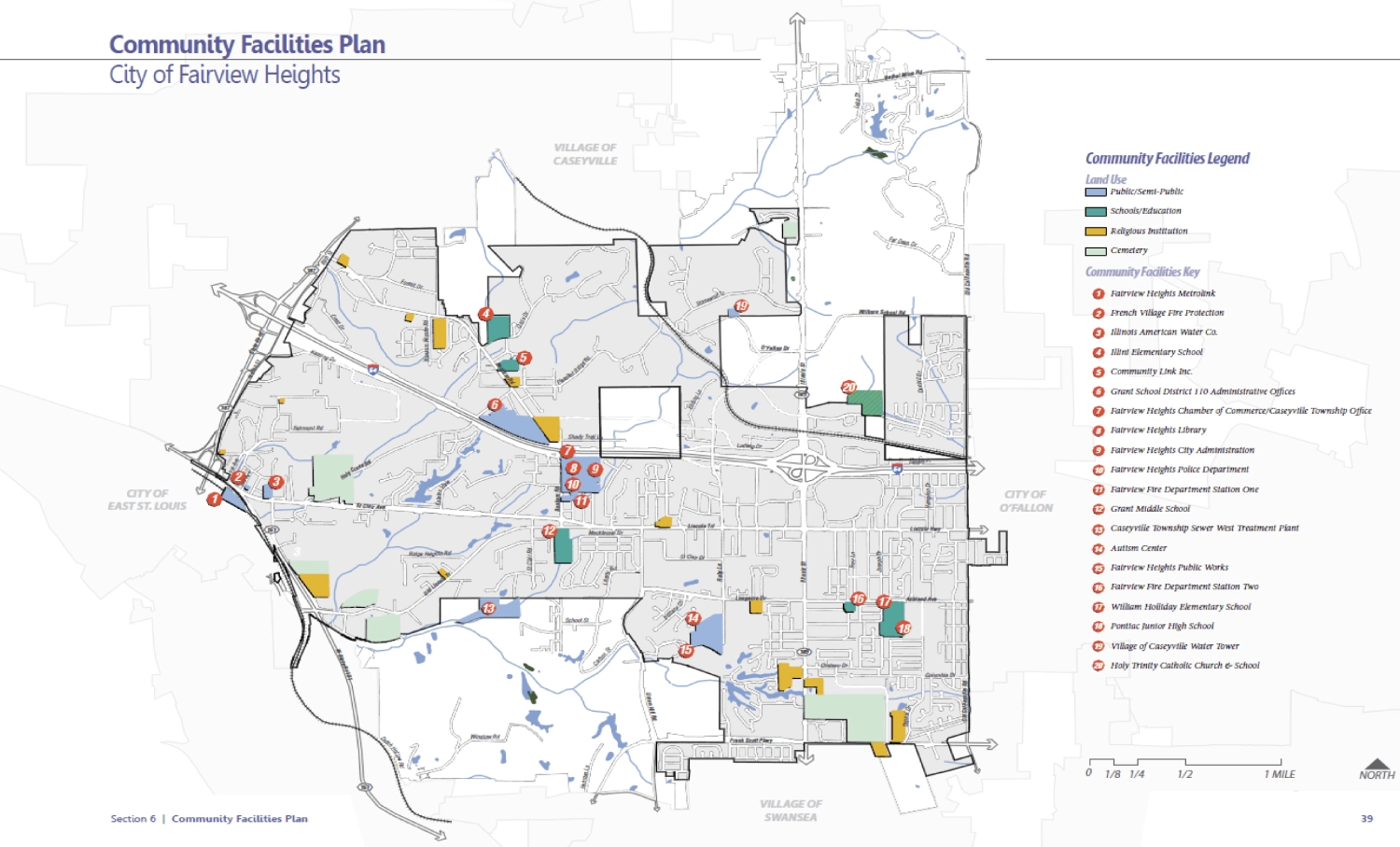
Residents and businesses in Fairview Heights received basic services from a variety of providers and community facilities. As Fariview Heights is well-established, the Community Facilities Plan (Right) largely reflects the locations of existing facilities and highlights anticipated fitire demand for services. The Plan also emphasizes coordination between the City and other local agencies and service providers with an interest in Fairview Heights to ensure the greatest level of efficiency in the provision of infrastructure and basic services.
"EDIA (Sales Tax Rebate) Requirements "
- If the property subject to this agreement is vacant:
1. That the property has remained vacant for at least one year, or
2. That any building located on the property was demolished within the last year and that the building would have qualified under findings (2) of this section; - If the property subject to the agreement is currently developed:
1. That the buildings on the property no longer comply with current building codes, or
2. That the buildings on the property have remained less that significantly unoccupied or underutilized for a period of at least one year; - That the project is expected to create or retain job opportunities within the municipality;
- That the project will serve to further the development of adjacent areas;
- That without the agreement, the project would not be possible;
- That the developer meets high standards of creditworthiness and financial strength as demonstrated by one or more of the following:
1. Corporate debenture ratings of BBB or higher by Standard & Poor’s Corporation or Baa or higher by Moody’s Investors Service, Inc.;
2. A letter from a financial institution with assets of $10,000,000 or more attesting to the financial strength of the developer; or
3. Specific evidence of equity financing for not less than 10% of the total project costs; - That the project will strengthen the commercial sector of the municipality;
- That the project will enhance the tax base of the municipality; and
- That the agreement is made in the best interest of the municipality.
Apply for EDIA (Sales Tax Rebate)
Prior to the City executing the Development Agreement, the applicant must pay a Business Assistance application fee equal to 2% of the total project cost, not to exceed $500.00. The fee covers the cost of legal review, analysis, and processing of the application. The fee is non-refundable, but should the project be delayed or terminated by actions of the City of Fairview Heights, such fee will be reimbursed.
The EDIA application process is detailed in the documents bellow. If you wish to apply to join the Enterprise Zone, follow the link through the “EDIA Application” button.
Lincoln Trail TIF Façade & Site Improvement Program
The Lincoln Trail TIF Façade & Site Improvement Program offers a reimbursement grant at various percentages of the project cost based on the number of improvements made. The maximum amount available is capped at $75,000 for those applicants who qualify for the program.
blank
Goals
The Lincoln Trail TIF Façade & Site Improvement Program has been designed to promote the attraction and retention of business operations and enhance the interest in visiting the Lincoln Trail Corridor and Market Place Center. Property owners who utilize the program to make improvements are investing in the Lincoln Trail Redevelopment Area and over time will foster other owners to undertake improvements, and ultimately the taxable value of these improved properties will increase.
Recipient Eligibility
Property Eligibility
- Property must be located within boundaries of the Lincoln Trail TIF District
- Structure must have at least 50% of total floor space devoted to commercial use;
- Proposed improvements must be visible from public right-of-way; and
- Property must be subject to payment of property taxes.
Applicant Eligibility
- Applicant must be the property owner;
- Property must be current on payments for taxes, mortgages and City service accounts;
- Projects that have begun principle construction or façade and site alterations before final City Council grant approval will be ineligible for the façade and site improvements program;
- Owner must pay 100% of project costs prior to receiving facade and site grant; and
- Owner must obtain two qualified contractor bids. One hundred percent of Developer’s labor must be provided by contractors using labor provided by participating member trade unions affiliated with the Southwestern Illinois Building and Trades Council.
Recipient Limitations
All work must be performed in compliance with the City of Fairview Heights’ Building and Development Codes. Owner must obtain Certificate of Completion from City Code Enforcements Office prior to disbursement of façade and site grant monies;
Work involving structural members may, at the discretion of the City Code Enforcement Office, require the certificate of a registered architect or engineer;
Changes to the project plan after City Council approves the façade and site grant application, that significantly or materially alter the scope of work or aesthetic quality of the façade and site may be disqualified. To remain eligible, such projects must submit changes to the Director of Land Use, Planning and Community Development for approval;
Buildings receiving façade and site grants will be ineligible to receive additional façade and site grants for 36 months (3 years) after disbursement of funds;
Applicants will be required to submit a rendering of the project showing proposed façade improvements as well as site plan improvements with the application. The rendering need not be done by an architect or paid artist, but must accurately represent the intent, scope of work, and aesthetics the project is planned to achieve; and
Property must remain primarily commercial (50% or more of floor space) and be reasonably maintained for a minimum of three (3) years following completion of the façade and site work, and real estate taxes paid timely, or a portion of the grant will be returned to the City.
Apply for the Site Improvements Program
Prior to the City executing the Development Agreement, the applicant must pay a Business Assistance application fee equal to 2% of the total project cost, not to exceed $500.00. The fee covers the cost of legal review, analysis, and processing of the application. The fee is non-refundable, but should the project be delayed or terminated by actions of the City of Fairview Heights, such fee will be reimbursed.
The Lincoln Trail TIF Façade & Site Improvement Program standards are detailed in the documents attached. If you wish to apply to for the Lincoln Trail TIF Façade & Site Improvement Program, please download the application below and send it to the City of Fairview Heights’ Director of Land Use via the contact form below.
Contact Land Use & Development
Phone
Staff Directory
Dallas Alley | Director of Land Use & Development
Alley@cofh.org
618-489-2061
Mike Ehret | Plumbing Inspector
ehret@cofh.org
Joe Werner | Building Official
Sam James | Electrical Inspector
618-489-2169
Jeff Blair | Building Inspector
Jeff.Blair@cofh.org
Randall Hall | Clerk 1
Randall.Hall@cofh.org
Bobby Bond | Building Inspector
Bobby.Bond@cofh.org
618-489-2082
Julius Jackson | Building Inspector
Julius.Jackson@cofh.org
618-489-2066